Welcome to the TPM Action Planner
The TPM Action Planner, developed through the National Cooperative Highway Research Program (NCHRP) Project 20-24(127), builds on a review of TPM practice and phased practitioner outreach to identify, synthesize, and prioritize common challenges and issues associated with TPM implementation. It presents a TPM Action Plan designed to help agencies meet these challenges; the Action Plan is described in the following sections.
The TPM Action Planner is organized around a set of 18 Issue Areas and a related set of mitigation actions. Practitioners can use this tool to identify issues of interest, pick out pertinent mitigation actions from a connected set of candidates, and tailor an individualized plan of action with a structure for capturing the desired outcomes, potential benefits, associated costs, responsible parties, and other factors.
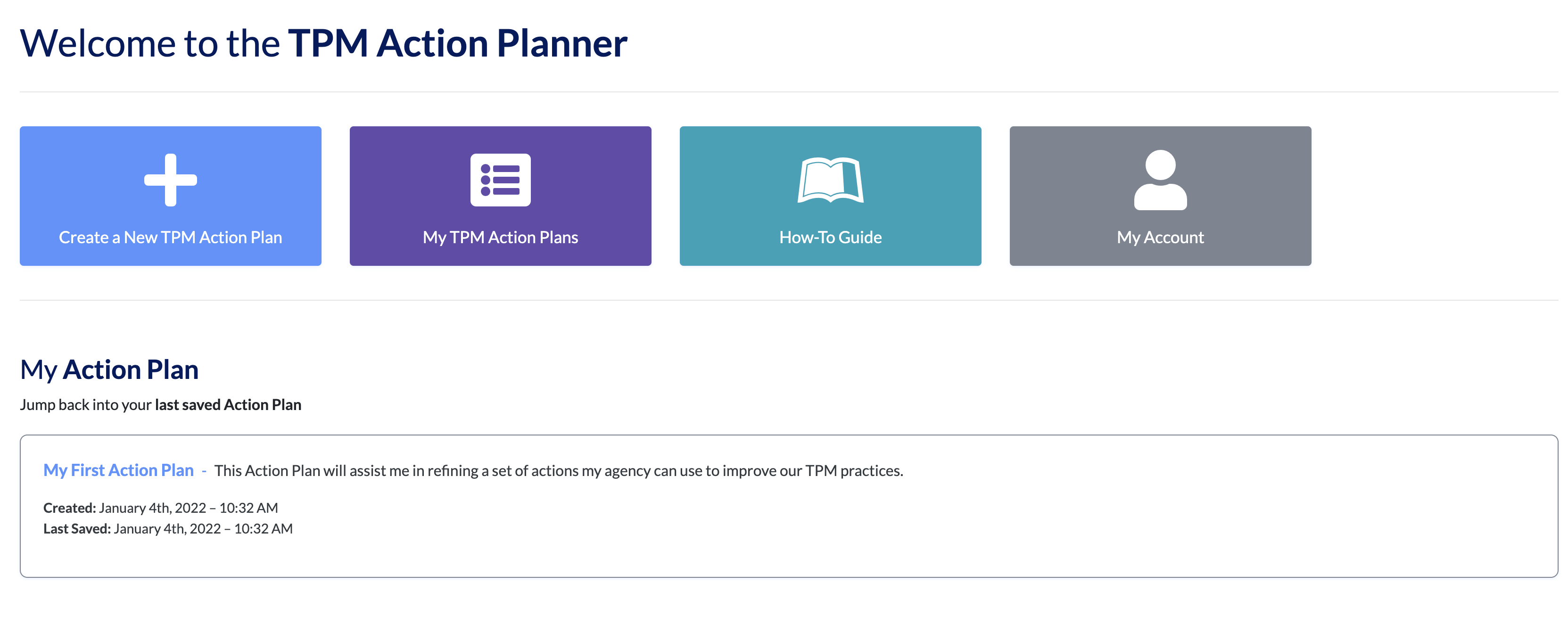 The home screen for the TPM Action Planner.
To make use of this tool, you need an account. Please either:
There are several ways specific audiences may wish use this resource:
- Agency practitioners and regional planning partners facing a TPM issue or challenge may look through the tool's TPM Issues identify matching issues, and then use this document to reference the connected set of candidate mitigation actions. They may choose to prioritize the mitigation actions based on based on the anticipated cost or complexity, applicable performance area(s), or their agency’s existing organizational priorities and other factors and may work collaboratively to more fully specify the costs and potential benefits.
- An AASHTO or TRB Committee, Subcommittee or Topic-Area Work Group developing research statements, an event-based workshop, or an organizational or strategic plan, may scope candidate mitigation actions by a particular mitigation type or strategy and prioritize among candidate mitigation actions within that type.
- FHWA, FTA, AASHTO and other organizations may use this tool to identify prioritized issues and their associated candidate mitigation actions to prioritize capacity-building efforts to advance TPM implementation. Depending on their area(s) of expertise, staff from these agencies and organizations may use the tool to direct their efforts at resolving issues within specific performance areas or related to specific TPM processes.